
Update & penalty recovery
Have you been penalised?
Does this chart look familiar? Traffic that runs steady for months and one day switches off: that is the signature of a penalty or an algorithmic hit. If your Search Console looks like this, the next moves matter more than anything: diagnosis first, then recovery.
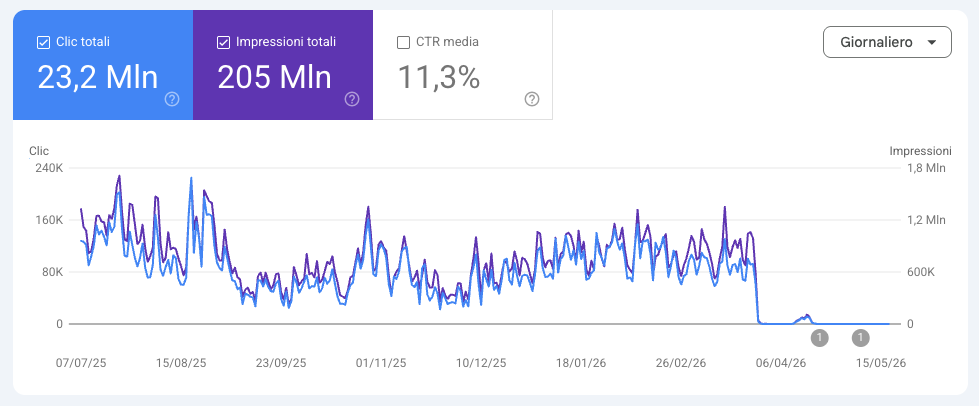
Diagnosis first: when the decline began, what it can be attributed to, whether it hit only you or the whole market. Then the recovery plan.
When traffic collapses, the first question is not “what do I do” but “what happened”. A manual penalty, an algorithmic demotion and a movement affecting the whole market are three different problems with three different cures. That is where we start: our observatory crosses the signals of the publishing market every day (Discover volatility, update effects, sector movements), so we can tell a blow aimed at your site from a wave that hit everyone.
Drops, measured in the field
twice a day
our reading of publishing market signals: volatility, updates, sector movements
up to −90%
the size of the declines an update can inflict: we measure them, we do not retell them
0-10
the Sequel Index, our public index of Discover market volatility
16 months
of history we use to reconstruct when and how a decline actually began
Update and penalty recovery: how we work
Forensic diagnosis of the drop
When it really started.
We reconstruct from the time series the exact day of the step down: declines often begin weeks before anyone notices, and must be attributed to the event of that period, not to the latest update in the news. Without this date, every recovery plan starts from the wrong place.
Attribution: update, penalty or market
Three different problems, three different cures.
We measure the effect of every Google update on your site (before and after, in numbers) and cross it with our observatory's market signals: if the market was calm while you were falling, the blow is specific to your domain. It is the step almost everyone skips, and the one that decides the strategy.
Manual actions and reconsideration
Cleanup, documentation, reconsideration request.
If Search Console shows a manual action, the path is codified: removing the causes, documenting the cleanup, writing the reconsideration request the way Google expects it. We walk you through every step, with no impossible promises on timing.
Quality and E-E-A-T recovery plan
Quality, bylines, sources: what Google reassesses.
From the helpful content systems to the spam policies, algorithmic declines are recovered by working on quality, trustworthiness and real usefulness: bylines and expertise, topical coherence, trust signals, technical hygiene. A plan ordered by impact, not by habit.
YMYL specialisation: health, finance, news
Where Google raises the bar.
YMYL (Your Money or Your Life) covers the topics that touch people's health, money, safety and rights: there Google applies its strictest quality and trust standards, and post-update declines are more frequent and deeper. It is the ground we work on most, with news, health and finance publishers: recovery runs through real authority, qualified bylines and verifiable sources, not technical tweaks.
Monitoring and prevention
Baselines, alerts and a reading of every new update.
After the recovery, the watch: expected baselines, alerts on anomalies, and a reading of every new update from our observatory, so that next time the diagnosis is ready while others are still trying to understand.
How we work on a drop
01
Forensic snapshot
Search Console access, series reconstruction over 16 months, date of the step down, affected surfaces (Search, Discover, News), market comparison. Within days you know what happened, when, and how serious it is.
02
Plan by priority
Probable causes become interventions ordered by impact: what to do now, what to prepare, what not to do (often the most valuable item). With clear timing and ownership.
03
Execution and verification
We work with your newsroom or team on the interventions and measure the traffic response through every crawl cycle and every following update. Recovery is proven with numbers, not feelings.
Results in the field
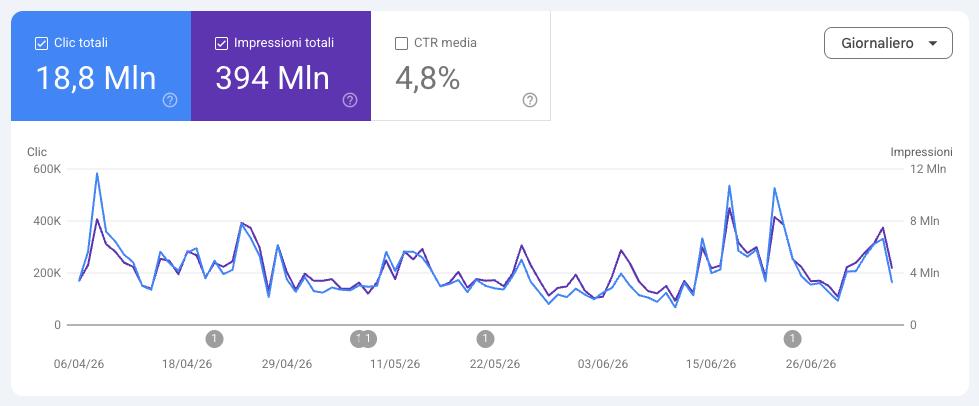
Traffic that grows back
We work every day with major publishers, the industry that has seen more updates than anyone else. Reading the drop correctly is what separates a recovery measured in months from a decline that becomes permanent: these are real trajectories followed by our team.

Let's talk
Did your traffic collapse?
Tell us what happened and since when. We reply within one business day with a first reading and the steps for the full diagnosis.
Thank you. We'll be in touch shortly.
Frequently asked questions
A manual penalty is an explicit action: you find it in Search Console under Manual actions, with the reason. Update-driven declines carry no notice: traffic falls in coincidence with an algorithm update. Then there is the third case, the most underrated: market movement, where many sites fall (or rise) together. We tell them apart by measuring the update's effect on your site and crossing it with our observatory's market signals.
First of all: do not delete or overhaul anything on impulse. You need the diagnosis: when the decline really began (often earlier than it seems), which sections and surfaces are affected, what the data says relative to the rest of the market. Google itself says that after a core update there is quality, usefulness and trustworthiness to improve, not a technical bug to fix, and rushed moves make things worse.
It depends on the cause. A manual action can be resolved in weeks after the cleanup and reconsideration. A core update decline normally requires demonstrating quality over time: meaningful movements often appear at the following updates, so the realistic horizon is months. Anyone promising recovery from a core update in two weeks is not telling you the truth.
Because most declines are an algorithmic reassessment of the site, or a redistribution of visibility in your market, not a penalty. In both cases there is a data-driven path across quality, authority and trust signals: no switch to flip back on.
YMYL stands for Your Money or Your Life: content that can affect people's health, money, safety or rights, so healthcare and wellbeing, finance and investing, news and civic topics, legal matters. On these topics Google applies its highest trust standards (its guidelines demand expertise and verifiable sources), because a wrong answer causes real harm. That is why YMYL sites are the most exposed to core updates: the E-E-A-T bar rises at every rollout, and whoever falls short loses visibility without having done anything "wrong". It is our specialisation: most of the publishers we follow work in health, finance and news.
The weight of evidence changes. On a YMYL site, recovery requires demonstrating real competence: who writes and with which credentials, which sources are cited, how errors are corrected, how transparent the publication is about ownership and contacts. Google weighs these signals more strictly than elsewhere, so editorial and transparency work counts more than technical work. The good news: precisely because the bar is high, whoever clears it takes the visibility others leave behind.
Almost never. Discover is the most volatile surface there is: returns from spikes, physiological content turnover and eligibility demotions are three different phenomena that look identical in analytics. They must be read on the time series and against the market: which is exactly the work of our observatory, crossing Discover market signals every day.
Read access to your Google Search Console (and GA4, if you also want the engagement side). From there we reconstruct up to 16 months of history and produce the diagnosis. No changes to the site are required at this stage.