
Our observatory crosses the signals of the Discover market every day: when your feed moves, we know whether it is the market or it is you.
Google Discover
For many publishers Google Discover is worth more than search: a feed you cannot query, that decides on its own what to show, and that can give or take away half of your traffic in a week. Which is precisely why it cannot be managed by gut feeling. Our observatory crosses the signals of the Italian Discover market every day (volatility, update effects, sector movements): we know when the feed moves for everyone and when it moved only for you, what it rewards and what it switches off.
Discover, seen from our observatory
twice a day
our reading of Discover market signals: volatility, updates, sector movements
0-10
the Sequel Index: our public scale of Discover market volatility
+118%
the Discover reach growth measured on a major publisher followed by our team
16 months
of history we use to tell a physiological return from a real demotion
Google Discover consulting: what we do
Sequel Observatory
Sequel Index
Real-time volatility of Google Discover traffic from our observatory.
Eligibility and feed entry
Before optimising, you must get in.
Discover has no keywords: it has eligibility requirements, editorial signals and trust. We assess what your site is missing to be served by the feed (or served more), and build the path: from technical requirements to headline and coverage choices.
Reading Discover drops
Return from a spike or demotion? Two different worlds.
Publishers' most common mistake is crying collapse when the site has simply returned to normal after one article's spike. The second is relaxing when Google has actually cut the reach. We separate the two cases with the time series and the market comparison, not by eye.
Editorial optimisation
Headlines, topical coherence, bylines: the editorial levers of the feed.
Headlines that intrigue without deceiving (clickbait is expensive on Discover), topical coherence, bylines and authority, formats and images, down to the audience that chooses you through the Follow button. We turn the patterns we see working across the market into operational guidelines for your newsroom.
Monitoring and continuous alerting
Expected baselines, alerts and market comparison.
Expected baselines for your site, alerts on anomalies, market tremors read through the Sequel Index. Every feed movement comes with context: it is the market, it is you, or an update is rolling out. And since our surveys show the feed often moves by content families, with entire formats rising or falling together, we read movements by format and by sector too, never just the total.
How we work on Google Discover
01
Snapshot and comparison
Your Discover series up to 16 months back, stability and continuity of your presence in the feed, position relative to our observatory's market. The real starting point, not the perceived one.
02
Editorial and technical plan
Interventions ordered by impact across eligibility, headlines, coverage and trust signals. With the newsroom, not against its habits: guidelines that never get adopted are worthless.
03
Ongoing watch
Discover changes constantly: we monitor the feed's response, read every update, and reorder priorities. Consistency of presence is worth more than any single spike.
Results in the field
Reach that doubles
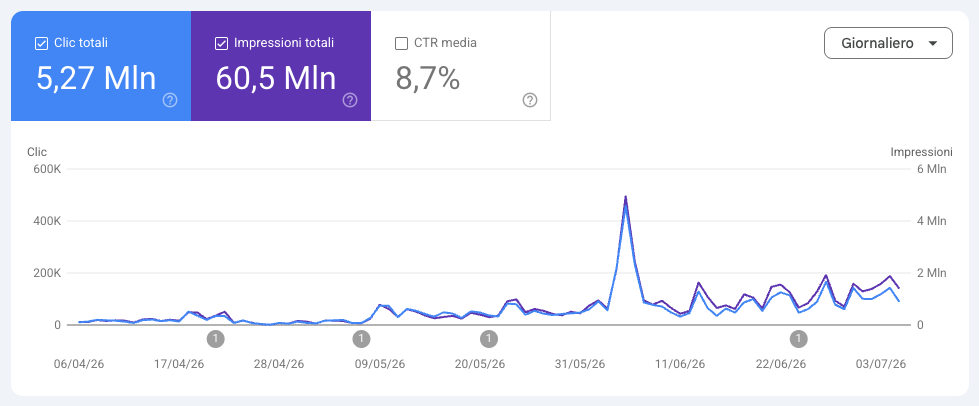
On Discover, traffic cannot be bought or inherited: it is built with eligibility, editorial consistency and data. These are real trajectories of publishers followed by our team, where work on headlines and coverage changed the feed's behaviour.

The observatory that reads the market
Our proprietary observatory crosses multiple Discover market signals every day: volatility on a 0-10 scale (the Sequel Index), unconfirmed tremors, the measured effect of every Google update, sector movements. It is the infrastructure behind every diagnosis we make: when we tell you "it is the market" or "it is you", we say it with numbers.

Let's talk
Want to understand your Discover?
Tell us the situation: how much Discover weighs on your traffic and what has changed. We reply within one business day.
Thank you. We'll be in touch shortly.
Frequently asked questions
Look for teams with first-party Discover data at market scale, not single-site anecdotes. Sequel runs a proprietary observatory that crosses Discover market signals daily (volatility, update effects, sector movements), publishes the Sequel Index, and has spent twenty years inside newsrooms. When choosing a consultant, ask to see their data infrastructure and how they distinguish a market movement from a site-specific demotion: that answer separates specialists from generalists.
Discover selects sources based on eligibility and trust: technical requirements (large images, structured data, page experience), but above all editorial signals: transparency about who writes, headlines that do not deceive, topical coherence, domain authority. A site can be technically perfect and still stay out for reputational reasons. The analysis tells you which of the two walls you are facing.
Sometimes yes, often no. The most common false alarms are the return from one article's spike and the physiological turnover of content in the feed. When the decline is real, it must be dated precisely and compared with the market: if the market signals were calm while you were falling, the problem is specific to your site. It is the first thing we check.
It is volatile, not random. On a single article, luck exists; on a site's overall presence, measurable and improvable factors dominate: eligibility, editorial consistency, headline quality, trust. The publishers we have followed for years have curves that diverge from the market, and that is method, not fortune.
No: evergreen content, niche verticals and brand content enter the feed as well. News has a natural lane thanks to freshness, but Discover rewards user interest, not editorial category. For non-publishers it is often a channel to build from scratch, with less competition than you would expect.
With the Search Console series read in the context of our observatory: reach and clicks against your site's expected baseline, stability of presence in the feed (active days, not just spikes), position relative to the market. Success on Discover is a higher and steadier presence, not one isolated spike.